
Key Takeaways
- Agencies shift from one-off creator hires to a repeatable production-to-testing loop that turns AI UGC into a continuous creative-testing machine.
- The seven-step workflow covers brief and research, scriptwriting, AI presenter selection, production and variation generation, compliance review, paid testing, and performance feedback into the next batch.
- Sozee supports locked likeness across all assets, reusable environments and assets, and an Agent that sets up shoots across a full client roster simultaneously.
- AI UGC excels on scale, speed, consistency, and cost per variation, while traditional creator UGC still leads in authenticity-sensitive categories where lived experience matters.
- Sozee covers the full loop — Cast, Direct, Create, Refine, Publish, Learn, Repeat — without exporting to five other tools.
Turn Your UGC Workflow Into A Testing Machine
How Agencies Use AI For UGC — The Full Workflow
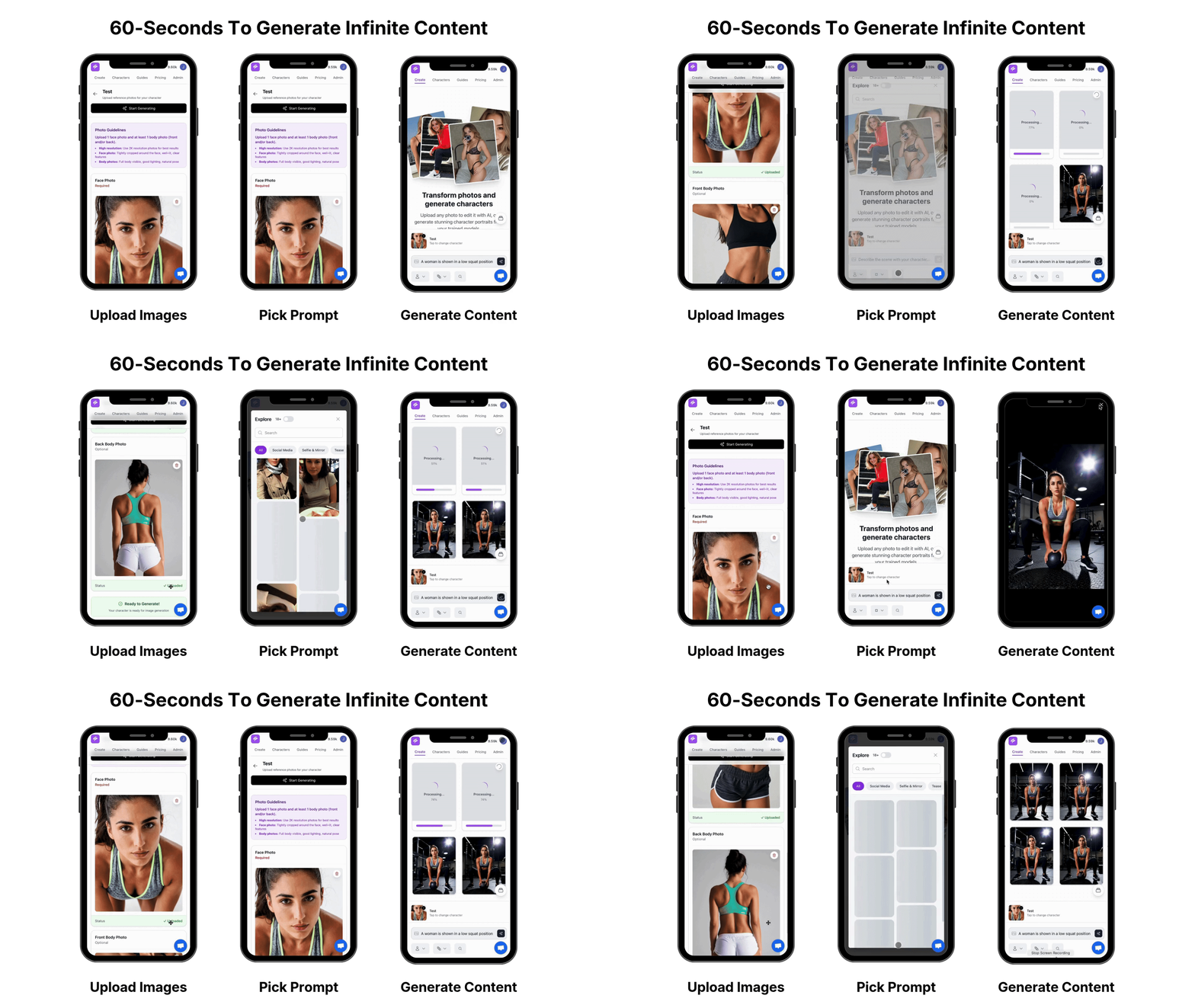
This seven-step workflow shows how agencies produce and test AI UGC ads at scale.
Step 1: Client Brief and Research
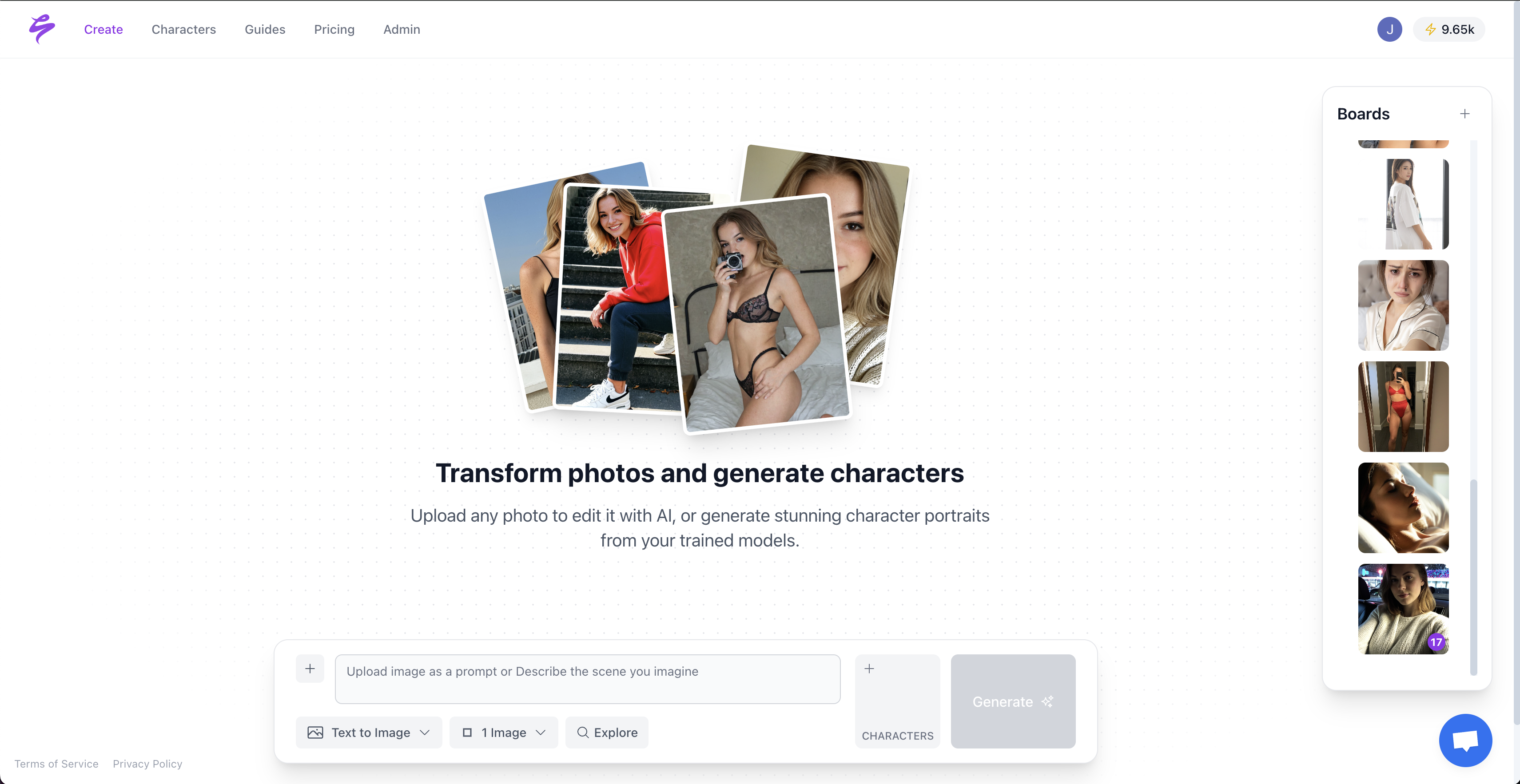
The brief defines the hook angle, the target persona, the platform-native format, and the compliance boundaries before a single frame is generated. Agencies mine buyer language from reviews, support tickets, search queries, and competitor comments to build a hook library tagged by persona, product, and objection. The brief specifies the target platform — Meta, TikTok, or YouTube — because each demands different pacing. TikTok rewards fast pacing where the first frame earns the second. Meta feed ads assume silent viewing, with captions carrying the full message. Instagram Reels sits between the two in production polish. Compliance boundaries such as claim limits, disclosure requirements, and category restrictions are set at this stage.
Step 2: Scriptwriting and Hook Generation
The goal is volume of hooks and scripts, not a single perfect draft. Practitioners testing 20 to 50 hook variations per product consistently outperform those running fewer than 10 complete ads, finding winners faster and at lower cost per insight. Agencies use AI to draft multiple hooks and scripts per concept, then route them for human review. The opening 3 seconds — the hook — is the single highest-leverage testing variable. Holding the script body, creator or avatar, and CTA constant produces clean data on what stops the scroll versus what loses it. A strategist selects the strongest candidates based on platform, audience, and offer before production begins.
Step 3: AI Presenter and Avatar Selection
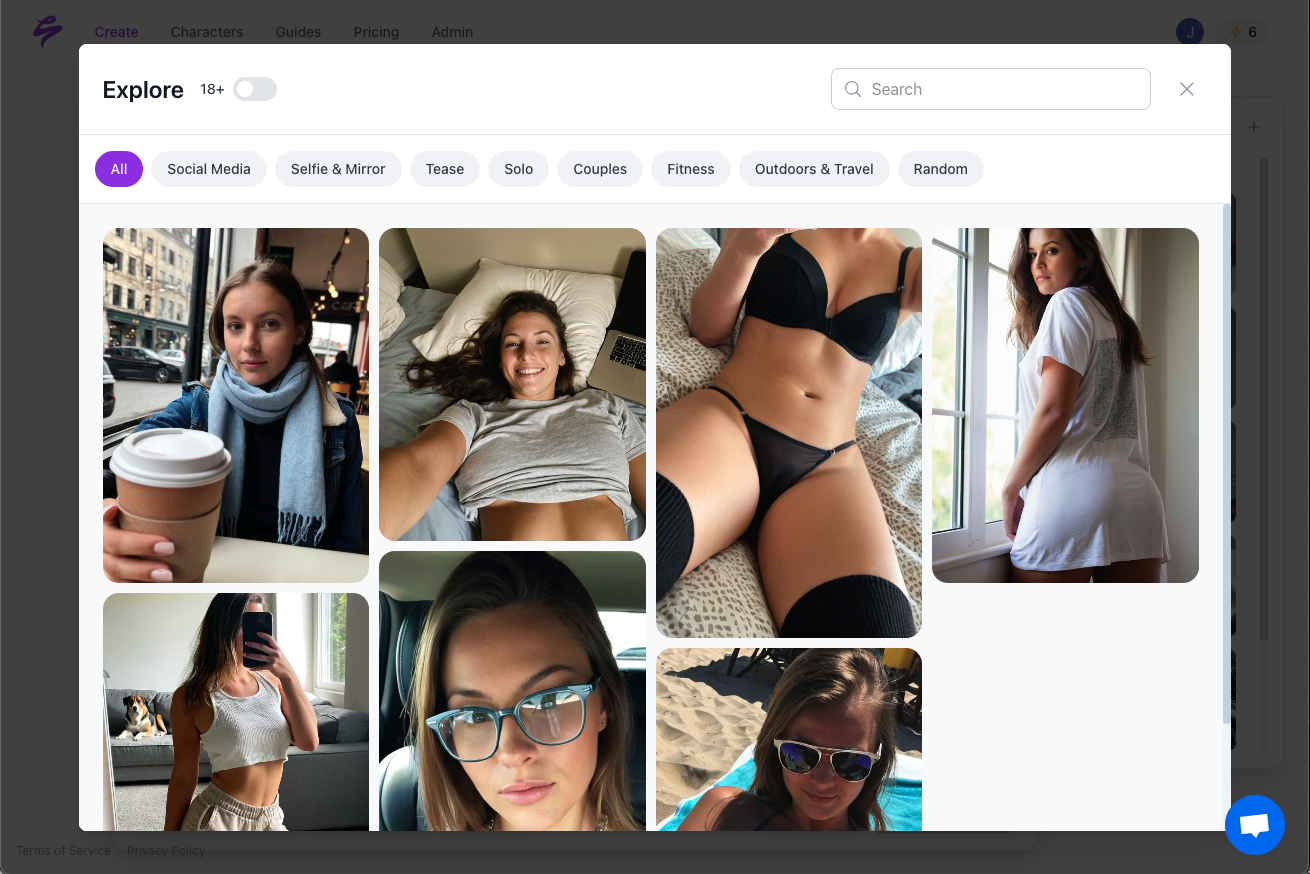
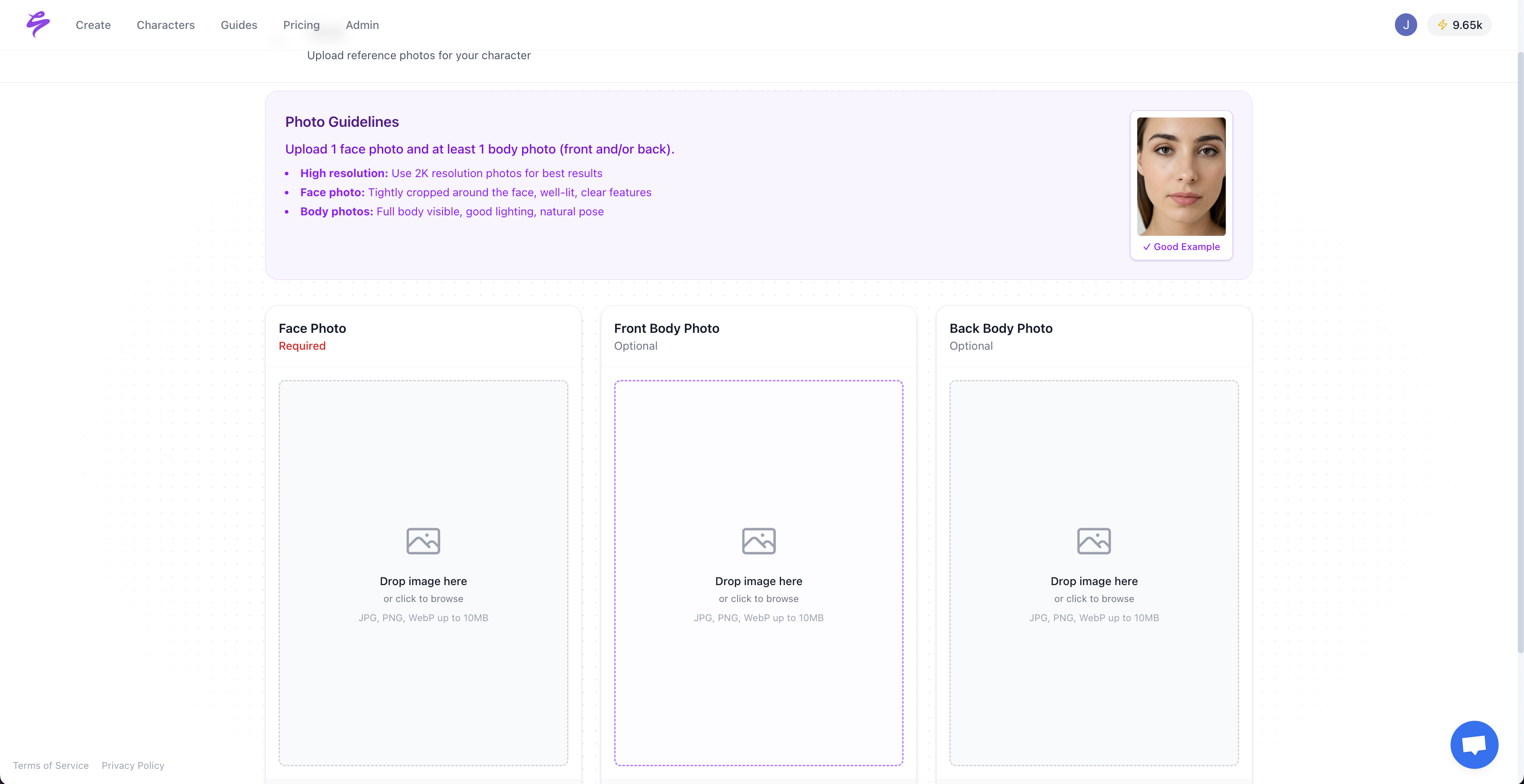
This step is where Sozee gives agencies the clearest edge. Upload as few as three photos and Sozee reconstructs a creator’s likeness with hyper-realistic accuracy. Agencies can also generate an entirely original character from scratch, a face that has never existed, consistent from the first frame. Sozee’s Character Builder generates front, quarter-turn, side profile, and back angles from a single face image. Add a front and back body shot and the character is complete. The critical differentiator for agencies is locked likeness: same face, same body, every frame, every client, every week. Cloning a real creator’s face and voice with a paid likeness license lifts performance 15–30% over stock avatars because the face feels specific rather than generic. Locked likeness makes brand consistency possible across a roster.
Step 4: Production and Variation Generation
Sozee’s Photo Control turns the prompt bar into a director’s panel across five dimensions: Setting, Outfit, Shot style, Expression, and Object. Each slot is filled by upload, library pull, or inline @-reference, so you can direct a shot without rewriting a prompt. Photo Shoot then takes a single image and builds a coherent, locked set of up to ten around it. Identity, outfit, and environment stay locked while angle, pose, and expression move. Because each setting is built from up to four reference shots, outfits assemble from one piece per category, and up to four props per set, every element becomes a reusable asset that compounds instead of a prompt you retype. Synthetic UGC platforms allow generating additional video variations at minimal incremental cost, enabling testing of five hooks, ten product angles, or twenty presenter styles in minutes rather than weeks. Every element built for one client becomes a permanent asset that makes the next shoot faster.
Step 5: Compliance Review
Compliance review happens before any asset leaves the studio. Agencies check disclosure requirements, platform policies, and claim boundaries before scheduling or launching. See the compliance section below for the full framework. Building disclosure into the creative brief at Step 1 keeps it from becoming a scramble after a platform warning.
Step 6: Paid Testing and Distribution
Agencies run AI UGC ads across Meta, TikTok, and YouTube using structured testing. A proven Meta and TikTok testing structure is one ABO campaign with 5 ad sets of 4 creative variations each, $20–30/day per ad set, a 3-day learning window, then killing the bottom 50% and doubling budget on the top 25%. Once the test structure is set, Sozee’s Scheduler handles distribution. It connects Instagram, TikTok, X, Facebook, Reddit, and Fanvue per character, not per account. It supports photos, carousels, reels, and stories, each with its own caption and a live preview. To measure what that distribution produced, Sozee’s Analytics tracks impressions, reach, likes, comments, shares, and engagement. The split between what Sozee posted and what the agency posted makes the contribution measurable and defensible in a client meeting.
Step 7: Performance Feedback Into The Next Batch
This step turns AI UGC into an economic engine. The agency sells a continuous creative-testing machine, not individual AI videos. Performance data from current campaigns informs the next generation of creative, accelerating the test-learn-iterate loop. Sozee’s Agent reads characters, library, and performance data, then proposes and produces the next setup. It writes into the real prompt and the real Photo Control panel so the conversation ends with the shoot one tap from Generate. Agencies that compound this loop monthly by updating retargeting with winning hooks, assigning reason codes to dead hooks, and growing the creative library start each month from a higher baseline than the last.
Start Building Your First AI UGC Loop
Even with this workflow in place, agencies tend to hit the same recurring pitfalls. Avoiding them keeps the loop compounding instead of stalling.
Common Pitfalls
- Re-Rolling Prompts Instead Of Using Direction Controls
- Using AI Presenters For Fake Testimonials
- Skipping Disclosure Before Launch
- Failing To Save And Reuse Assets Across Clients
- Not Feeding Performance Data Back Into The Next Production Batch
Success Metrics
- More Variations Tested Per Month Without Adding Headcount
- Faster Production Cycles From Brief To Live Ad
- Consistent Brand Presentation Across A Full Client Roster
- Measurable Engagement Lift Tracked Through Analytics
- Capacity To Onboard More Clients Without Scaling Creator Costs
Next Steps For Agencies
- Build Reusable Environments For Each Client In Sozee’s Setting Library
- Use The Agent To Set Up Shoots Across A Full Roster Simultaneously
- Connect Sozee Analytics To Media Buying Feedback For Weekly Hook Decisions
Are AI UGC Ads Legal? The Compliance Line
As of 2026, AI UGC ads are generally permissible with proper disclosure. The key distinction for agencies is the difference between an AI presenter and a fake testimonial.
An AI presenter is an AI-generated character delivering a scripted message. A fake testimonial is an AI-generated person presented as a real customer with real experience. The FTC’s endorsement guides state that influencers cannot talk about their experience with a product they have not tried, cannot say a product they were paid to talk about is good if they thought it was terrible, and cannot make up claims about a product that would require proof the advertiser does not have. The scripted AI presenter is generally permissible with disclosure. The fake testimonial risks deception under FTC rules, with civil penalties up to $53,088 per occurrence under current FTC enforcement rules.
The FTC’s Disclosures 101 for Social Media Influencers states that a disclosure should be placed with the endorsement message itself, should not be mixed into a group of hashtags or links, and should be in the same language as the endorsement. For video, viewers are more likely to notice disclosures made in both audio and video, because some viewers may watch without sound and others may not notice superimposed words.
Platform-level requirements add a second layer. TikTok Ads Manager requires advertisers to check the toggle labeled “This ad contains AI-generated content” during ad creation when the ad is a TikTok ad (not a Spark ad) and its content includes image, video, or audio that is either completely AI-generated or significantly modified by AI. Meta automatically labels Facebook and Instagram ad content created or edited using Meta’s generative AI tools or third-party generative AI tools such as Photoshop or Dall-E, with the AI disclosure appearing in the ad’s “About this ad” element, using industry-standard detection methods such as C2PA to identify when ad content has been created or edited using third-party generative AI tools.
Sozee provides compliance and verification built into setup, not legal counsel. Agencies should consult qualified legal counsel for jurisdiction-specific advice, particularly given that the EU AI Act’s Article 50 requires deepfake disclosure from 2 August 2026, and approximately 30 US states have passed regulations requiring disclaimers in political advertising.
How Much Do AI UGC Ads Cost?
Cost depends on volume of variations, number of characters, video versus still output, localization, and platform distribution. For a detailed derivation of agency UGC production costs, see the Ultimate 2026 Guide to Agency UGC Production Costs.
The structural cost advantage of AI UGC is significant. Live-shot UGC costs $300–500 per creative and takes 3–7 days to produce, while AI UGC with a cloned creator costs $5–15 and takes 20 minutes. Traditional UGC production can require waiting two weeks for performance data and then three additional weeks to produce new creator content based on those insights, while the full test-learn-create cycle with synthetic UGC can compress to days or even hours.
For agencies, Sozee’s Teams and workspaces are the cost-efficient operating model. One login covers every client while keeping work fully isolated, with each workspace holding its own characters, vault, connected accounts, and credits. This structure removes the per-client tool overhead that erodes margin at scale.
AI UGC vs. Traditional Creator UGC — When Real Creators Still Win
The table below compares AI UGC and traditional creator UGC on the variables agencies weigh most: production speed, cost per variation, brand consistency, and best use case.
| Attribute | AI UGC | Traditional Creator UGC |
|---|---|---|
| Production speed | Minutes to hours | Days to weeks |
| Cost per variation | $5–15 (cloned creator) | $300–500 |
| Brand consistency | Locked likeness across all assets | Varies by shoot |
| Best use case | Volume testing, rapid iteration | Authenticity-sensitive categories, regulated claims |
AI UGC wins on scale, speed, consistency, and cost per variation. A split test allocating $100K of Meta spend across 220 video creatives found human UGC won click-through at 2.4% vs 1.9%, while AI creative won ROAS at 2.8x vs 2.3x, with the author noting “AI’s higher ROAS is driven by production economics, not by superior ad performance.” Traditional creator UGC still wins in authenticity-sensitive categories such as skincare with medical claims, financial products, and fitness transformation, where audiences respond to visible lived experience.
Sozee lets agencies run both. Real creators’ likenesses can be locked and scaled at volume, or agencies can use fully AI-generated characters for categories where that approach works. The same platform handles both without exporting to a separate tool.
How Agencies Package and Price AI UGC
The client-facing model that holds is the retainer. Clients buy a monthly volume of tested variations, a continuous creative-testing machine, instead of a single deliverable. Full-service AI UGC retainers include a dedicated strategist, a weekly hook-testing cadence, and reporting tied to actual CPA rather than vanity view counts.
Retainer tiers typically map to three variables: monthly video volume, number of platforms, and testing intensity. A published example of this structure has three tiers. The Launch tier is $2,000/mo and covers 12 AI UGC videos, 1 brand, 1 platform, and a weekly creative report. The Growth tier is $4,500/mo and covers 30 videos, 2 platforms, 1 AI-actor cast, and A/B hook testing. The Scale tier is $8,000/mo and covers 60 videos, multi-brand, a dedicated actor library, and performance reporting.
What is included in each tier determines whether the retainer is defensible in a client meeting. A complete retainer covers concepting, production, compliance review, scheduling, and reporting. Sozee’s Analytics provides the proof layer. The split between what Sozee posted and what the agency posted makes the platform’s contribution measurable and attributable. Clients buy a system that finds winning creative faster than their competitors.
The Tool Stack By Function
Agencies need tools for research and scripting, avatar and video generation, compliance review, creative testing, scheduling, and analytics. For a full comparison of tools by function, see the Best AI UGC Creator Tools Compared (2026) and the UGC Creator Agency Tools: The Operator’s Stack Guide.
Sozee covers the full loop — Cast, Direct, Create, Refine, Publish, Learn, Repeat — without exporting to five other tools. The moment requirements start changing — when a better avatar model ships or a client wants a different house style — a fixed pipeline becomes the bottleneck rather than the renderer. Sozee’s architecture is built so that the pipeline adapts without rebuilding.
Multilingual Localization
Agencies use AI UGC for multilingual localization by running the same character, with the same locked likeness, across different languages without reshooting. Sozee’s voice cloning and Voice Notes provide the mechanism. Teams type a message and the character delivers it in her own cloned voice, in any language the brief requires. Localizing a single AI UGC concept across markets runs roughly $500 per additional language when the brand owns the pipeline, versus $3,000–$8,000 per market when an agency requotes the shoot for each region. The locked likeness means every localized asset looks like the same person on the same day.
Localize Your Next Campaign With Sozee
Frequently Asked Questions
This FAQ section adds practical details that extend the workflow and compliance guidance above.
Are AI UGC Ads Legal?
Yes, when agencies follow disclosure rules and avoid fake testimonials. As noted in the compliance section, fake testimonials risk deception under FTC rules and carry civil penalties. Build disclosure into the brief and apply both FTC and platform-level guidance on every campaign.
Can I Be Sued For Using AI-Generated Images?
Legal risk depends on likeness rights, disclosure compliance, FTC rule adherence, and jurisdiction-specific regulations including the EU AI Act’s Article 50 and state-level laws such as New York’s synthetic content disclosure requirement. Sozee provides compliance and verification built into setup. Agencies should consult qualified legal counsel for advice specific to their markets and client categories. The FTC also notes that influencers should not rely solely on platform disclosure tools and should add their own clear disclosure.
How Much Do AI UGC Ads Cost?
Cost is driven by volume of variations, number of characters, video versus still output, localization requirements, and platform distribution. As covered in the cost section above, AI UGC runs at a fraction of live-shot production costs. For a full agency cost breakdown, see the Ultimate 2026 Guide to Agency UGC Production Costs. Sozee’s Teams and workspaces model — one login, every client, fully isolated — helps protect margin at scale.
What Is The Difference Between AI UGC And Traditional UGC?
AI UGC excels at scale, speed, consistency, and cost per variation. Traditional creator UGC leads in authenticity-sensitive categories and situations where a real person’s lived experience is the core of the message. In direct-response testing, AI UGC performs within 5–15% of live-shot UGC on CTR and CPA while winning on cost-per-creative by a significant margin. The practical agency model uses AI UGC for volume testing and hook discovery, then real creators for scaling proven winners in trust-dependent categories. Sozee supports both approaches.
How Do Agencies Disclose AI-Generated Content?
Agencies use platform-native disclosure tools as a baseline and then add clear, explicit disclosures in the creative. On TikTok, they check the “This ad contains AI-generated content” toggle in Ads Manager for qualifying non-Spark ads. On Meta, AI-generated content is automatically labeled via C2PA detection in the “About this ad” element, but agencies still add their own disclosure. Clear terms like “advertisement,” “ad,” or “sponsored” work, while vague abbreviations such as “sp” or “spon” do not. For video, disclosure appears in both audio and visual elements. Teams write this language into the creative brief at the start of every client engagement.
Can AI UGC Scale Across Multiple Clients?
Yes. Sozee’s Teams and workspaces provide one login for every client while keeping work fully isolated. Each workspace has its own characters, vault, connected accounts, and credits. The Agent can set up shoots across a full roster simultaneously. Reusable environments, outfit libraries, and object libraries built for one client become permanent assets that make every subsequent shoot faster. The compounding effect is the point: every shoot set up makes the next one faster, and the creative library grows with every production cycle.
Conclusion: The Operator’s Advantage
Agencies are bottlenecked by creator availability and struggle to scale creative testing fast enough to beat ad fatigue. The solution is a repeatable production-to-testing loop that runs continuously, feeds performance data back into every new batch, and compounds over time. Sozee is the only platform that covers the full loop — Cast, Direct, Create, Refine, Publish, Learn, Repeat — without exporting to five other tools. Locked likeness, reusable assets, an Agent that sets up shoots across a roster, and analytics that prove the platform’s contribution make Sozee a definitive AI UGC production platform for agencies. With Sozee, agencies scale creators instead of waiting on them.
Run Your Next UGC Campaign On Sozee