
Key Takeaways
- Consistent content without burnout requires a production system designed for your worst week. That system separates output from your physical availability.
- Start with a capacity audit to find your real production budget. Then set a minimum viable cadence that survives your worst week.
- Build a two-to-four-week content bank. Batch 70% to 80% of content, keep 20% to 30% flexible, and refill the bank in short, regular sessions.
- Separate production labor from identity labor. Install a production layer that removes decision fatigue and identity fatigue from day-to-day content work.
- Sozee is the AI Content Studio that locks likeness, reuses assets, and reduces identity and decision fatigue in ways scheduling tips and batching templates cannot.
How To Create Consistent Content Without Burnout: The Operating Rhythm
This operating rhythm fixes three common failure points: no capacity baseline, no minimum floor, and no recovery plan.
- Run a capacity audit. Before you set a cadence, you need to know what you are working with. Track one week of real content work and note where your energy peaks and crashes. Subtract non-negotiable commitments. The hours left are your true production budget, and every later decision depends on that number.
- Set a minimum viable cadence. Choose the lowest posting frequency that still moves your goals. Apply the worst-week test before you commit. If the cadence cannot survive your worst week, it is not your cadence.
- Build a two-to-four-week content bank. Batch 70% to 80% of content in focused sessions. Leave 20% to 30% flexible for timely or reactive posts so your calendar can respond to real events.
- Separate production labor from identity labor. Identify the work only you can do, such as your voice, your take, and your face. Then route executional work to systems or tools so your identity is not on the hook for every task.
- Install a production layer. Use a tool that handles scheduling, asset reuse, and setup decisions. Protect your creative energy for the work that truly needs you.
- Define your recovery protocol in advance. Decide now what you will do when the buffer empties and motivation drops. A pre-decided protocol prevents a bad week from turning into a month-long disappearance.
- Review and adjust cadence quarterly. Capacity changes across seasons. Schedule a review every quarter so you adjust the system before it breaks.
Watch This: [Video placeholder — embed a walkthrough of the five-step operating rhythm here, summarizing the capacity audit, minimum viable cadence, buffer math, and recovery protocol in under five minutes.]
The Capacity Audit: Calculate Your Real Content Hours Before You Set a Cadence
Most creators burn out because they set a cadence based on ambition instead of capacity. They build a schedule for their best week, with no appointments and full energy, and that schedule collapses as soon as a normal week arrives.
The capacity audit corrects this. Track one full week of actual content work. Log every hour spent on ideation, filming, editing, captioning, scheduling, and engagement. Note when energy is high and when it is low. Subtract non-negotiable commitments such as work, caregiving, health, and sleep. The hours remaining are your real production budget, not the hours you wish you had.
Capacity-based planning over ambition-based planning is the structural correction that prevents a common failure. A creator who has ten hours per week for content often builds a plan for twelve or fifteen, then blames themselves when the math breaks.
The World Health Organization classifies burnout in ICD-11 under code QD85 as an occupational phenomenon resulting from chronic workplace stress that has not been successfully managed. It is not a medical condition or a personal failing. For solo creators, the schedule is usually the problem, not the person holding it.
To make the audit concrete, use the worksheet below to log your content hours, energy peaks, and non-negotiable commitments for one week.
[Visual placeholder: Capacity Audit Worksheet — a downloadable template for tracking actual content hours, energy peaks, and non-negotiable commitments across one week.]
Minimum Viable Cadence: How Many Posts Per Week You Can Actually Sustain
A minimum viable cadence is the lowest posting frequency that still moves your goals and survives your worst week. A cadence that fails your worst week will not hold long enough to matter.
Cadence depends on capacity more than ambition. A 2025 posting-frequency analysis of approximately 11.4 million TikTok posts across 151,000 profiles found that moving from one weekly post to the two-to-five-posts-per-week range produced the largest efficiency gain. Higher frequencies created smaller returns relative to the extra output required. This supports starting low and building up.
Three posts per week, every week, for a year beats a daily streak that collapses after eighteen days because a client double-booked and the shoot never got rescheduled. Consistency compounds. Collapse does not.
[Visual placeholder: Worst-Week Test Decision Tree — an infographic walking creators through the question: “Can this cadence survive my worst week?” with branching paths to adjust frequency or buffer size.]
Common Pitfalls
- Building a cadence for the best week and treating it as the standard
- Treating batching as a cure-all before setting a sustainable floor
- Confusing volume burnout with identity burnout, where you feel exhausted by who you must be to do the work
The Buffer Math: How Big Your Content Bank Should Be
A content bank of two to four weeks absorbs a bad week without forcing a public disappearance. One week of buffer is thin because a single disruption can empty it. More than four weeks risks content going stale before it publishes.
Batching 70% to 80% of content while keeping 20% to 30% of the calendar flexible for trending topics, breaking news, or spontaneous posts is a practical split. A fully scheduled calendar leaves no room to respond to what is happening in your niche or culture.
Refill the buffer in short sessions, not marathon days. A first batching session of three hours, with one hour writing captions, one hour creating or sourcing visuals, and one hour polishing and scheduling, often produces 12–16 posts for solo creators. That output covers three to four posts per week for a month. The goal is a repeatable rhythm instead of a heroic production day that creates its own burnout.
The WHO classification of burnout as an occupational phenomenon caused by unmanaged chronic workplace stress frames the buffer as a safeguard. A two-to-four-week bank functions as operational stress management, not a luxury.
[Visual placeholder: Buffer Math: Two-to-Four-Week Content Bank — a diagram showing how to fill, maintain, and refill a content bank across a rolling monthly calendar.]
How you fill that buffer depends on the production rhythm you choose, and that choice is less obvious than most guides suggest.
Batching vs. Daily Posting: A Real Tradeoff, Not a Foregone Conclusion
Batching wins on efficiency and quality. Daily posting wins on timeliness and trend responsiveness. The right choice depends on content type and your energy pattern, and the wrong choice is any rhythm you cannot sustain.
Content types that benefit from batching include educational tutorials, thought leadership, series content, and anything that needs research or heavier production. Content types that lean on daily posting include reactions to news, trend participation, behind-the-scenes updates, and timely announcements. A hybrid approach that batches 70% of content and creates 30% in real time captures the strengths of both.
Content batching without burnout only works when the batch relies on production labor instead of identity labor. Most batching guides overlook this distinction.
Burnout says “I have too much work.” Identity fatigue says “I am exhausted by who I have to be to do the work.” A solo creator is the writer, the face on camera, the editor, the scheduler, and the comment responder. That is not volume burnout alone. It is the specific depletion of being the brand, the talent, and the producer at once. Discipline buys more time before the wall. It does not remove the wall.
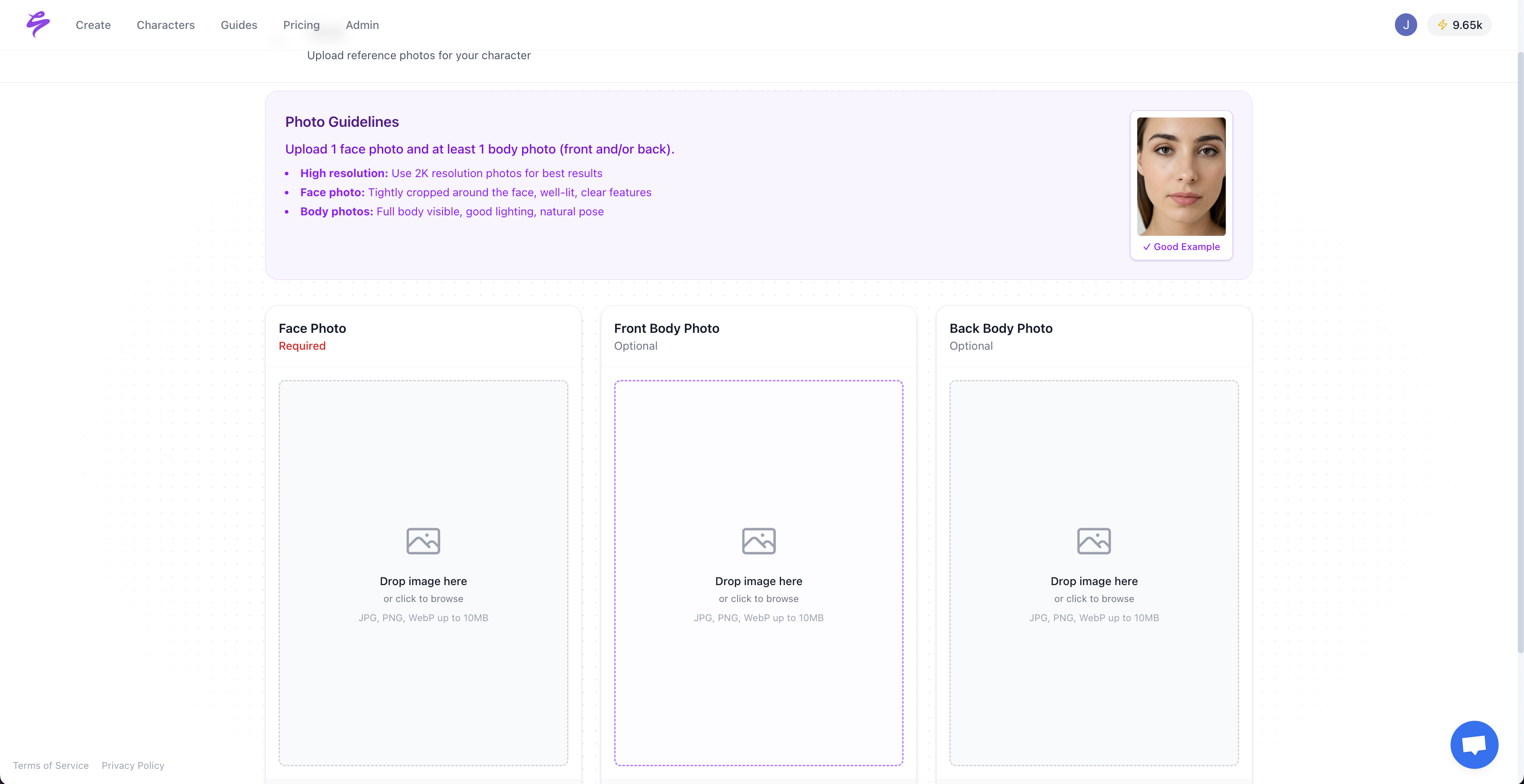
Sozee functions as the production layer that addresses identity and decision fatigue directly. Scheduling tips and batching templates do not touch these drivers. General-purpose AI tools have historically returned a different face, a different room, and a different body each time a prompt is entered. Sozee locks likeness instead. The same face, the same body, and the same world hold across every frame, set, and month so the creator directs rather than re-rolls.
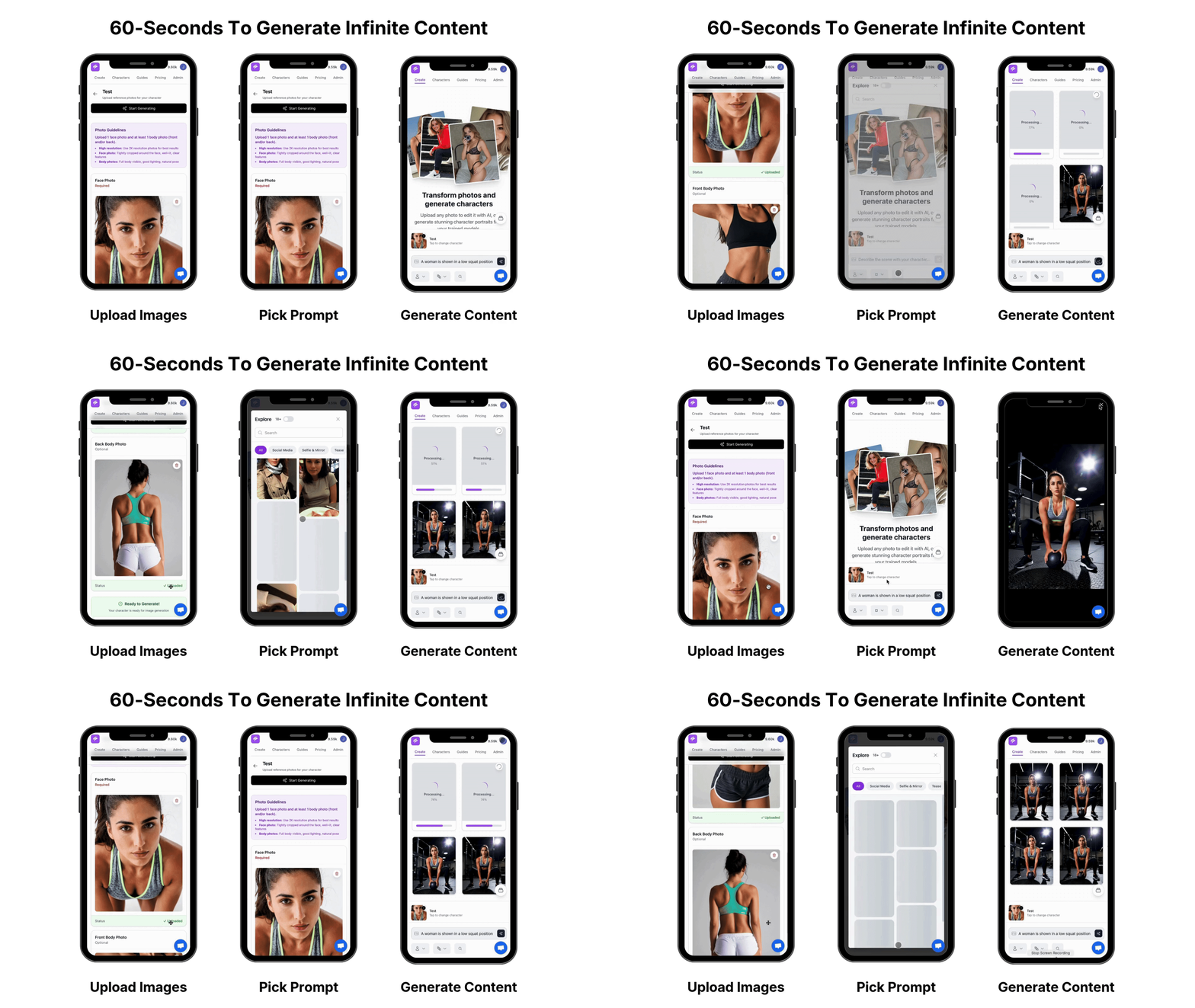
Sozee’s capabilities remove operational overhead that compounds identity fatigue:
- Locked likeness – the same face, body, and world hold frame to frame, set to set, and month to month, which removes re-creation costs that drain creative energy
- Reusable settings, outfits, and objects – assets compound over time instead of being rebuilt from scratch in every session
- Photo Shoot – one image becomes a locked, coherent set of up to ten, which can cover a month of content from a single frame
- Live Mode – real-time performance on a webcam or phone when the creator wants to act instead of produce
- The Agent – interviews a half-formed idea into a finished setup, one tap from Generate, and removes the decision fatigue of a blank prompt bar
- Native scheduling and analytics – across Instagram, TikTok, X, Facebook, Reddit, and Fanvue, with a clear split between what Sozee posted and what the creator posted
Sozee is the AI Content Studio for the Creator Economy. It serves agencies, top creators, micro-influencers, anonymous and niche creators, and virtual influencer builders. For the solo creator fighting burnout, its primary role is breaking the link between physical availability and content output. The table below shows how that plays out across the capabilities that matter most for burnout.
| Capability | Traditional Methods | General-Purpose AI Tools | Sozee |
|---|---|---|---|
| Likeness Consistency | Requires physical presence at every shoot, and consistency depends on lighting, styling, and scheduling | Returns a different face, body, or room with each prompt, with no locked identity across sessions | Likeness locked from three photos, with the same face, body, and world across every frame, set, and month |
| Reusable Assets | Settings, outfits, and props must be physically sourced, styled, and recreated for each shoot | No persistent asset library, so each prompt starts from scratch | Saved environments, outfit library, and object library, with every asset built once and reused |
| Identity Fatigue Reduction | Creator must be physically present as face, talent, and producer for every piece of content | Removes physical presence but reintroduces decision fatigue through open-ended prompting with unpredictable results | The Agent reduces prompt decision fatigue, and locked likeness plus reusable assets remove re-creation labor that drives identity exhaustion |
| Scheduling and Analytics | Requires separate scheduling tools and offers no native analytics split between creator-posted and tool-posted content | No native scheduling or analytics, so content must be exported to third-party tools | Native scheduling across Instagram, TikTok, X, Facebook, Reddit, and Fanvue, with analytics split between Sozee-posted and creator-posted content |
The 42% Rule: What It Explains and Where It Falls Short
The 42% rule is a heuristic suggesting roughly 10 hours per day, or about 42% of a 24-hour day, should be reserved for rest and recovery beyond sleep.
The rule was popularized by Emily and Amelia Nagoski in their 2019 book Burnout: The Secret to Unlocking the Stress Cycle. They frame it clearly: “We’re not saying you should take 42 percent of your time to rest; we’re saying if you don’t take the 42 percent, the 42 percent will take you.”
No single study identifies 42% as a precise threshold. It works as a planning framework instead of a clinical rule. Rest in this model includes sleep, movement, meals, hobbies, social connection, and downtime. The 42% requirement can average out over a week or a month instead of being met every day.
The rule helps by reframing rest as a biological requirement instead of a reward for finishing work. It remains incomplete because it does not address identity fatigue or structural workload mismatches. A creator who sleeps eight hours and takes two hours of downtime daily but spends every waking moment as the face, talent, and producer of their content can meet the 42% threshold and still burn out. The rule measures time, not the type of labor filling that time.
Failure Recovery: What To Do When Your Content System Collapses In Week Three
When the buffer is empty and motivation is gone, you can lower the floor without disappearing. Post the minimum, pause the non-essential, and restart the system without a shame spiral.
Most content guides explain how to avoid burnout. Very few provide a step-by-step protocol for the moment the system has already collapsed. The sequence below fills that gap and gives you a concrete path back to your baseline.
- Post the floor. Publish one low-effort, high-value piece such as a quote, a repost, or a simple photo. Maintain presence without a full production session.
- Pause the ceiling. Stop all non-essential content such as stories, reels, and engagement pods for one week. Focus on stopping the bleeding instead of catching up.
- Refill one slot. Spend 30 minutes adding one piece to the buffer. Keep it to a single piece so you avoid turning recovery into another marathon.
- Restart the rhythm. Resume the minimum viable cadence you already proved you can hold. Return to the cadence that passed the worst-week test.
Pro Tips: On the Shame Spiral
The shame spiral is the pattern that turns a bad week into a month-long disappearance. The system collapses, the creator feels they have failed their audience, and the failure feels too large to fix with a single post. They wait until they can return with something significant, and the wait stretches longer.
The protocol above interrupts the spiral at step one. One low-effort post is not a comeback. It is a signal, to the algorithm and to the creator, that the floor still exists. A two-week break may cause a short-term dip in metrics but does not harm long-term growth, while quitting entirely due to unrecovered burnout does.
[Visual placeholder: Failure Recovery Protocol — a flowchart mapping the four-step recovery sequence, with decision nodes for “Is the buffer empty?” and “Is motivation at zero?” leading to the floor-post, ceiling-pause, one-slot-refill, and rhythm-restart steps.]
Is Content Creation Still Worth It In 2026?
Content creation remains worth it when your system survives the worst week. Consistency still compounds, and sometimes posting less is the correct strategic move.
Creators should push through when engagement rate is above 4%, audience growth is stable or increasing, and craft is consistently improving, because the burnout is operational instead of strategic. Creators should pivot when engagement rate has been flat or declining for over 90 days, output quality is steady but audience growth has stopped, and the content category itself is contracting.
On AI and authenticity, AI works as a production lever instead of a creative replacement. The HubSpot 2026 State of Marketing report found that 80% of marketers now use AI for content creation, and the teams that outperform peers combine AI efficiency with human creativity and systemized workflows. The creators who last use AI to remove operational overhead such as scheduling, reformatting, and repurposing while protecting the creative work only they can do.
A July 2025 survey by Censuswide for Billion Dollar Boy, covering 1,000 creators across the US and UK, found that 52% of creators have experienced burnout as a direct result of their work, and 37% are actively considering leaving the industry. The creators who stay tend to have stronger infrastructure rather than more discipline.
Frequently Asked Questions (FAQ)
How Do I Create Consistent Content Without Burnout?
Build a production system that holds on your worst week. Start with a capacity audit to find your real available hours. Choose a minimum viable cadence that passes the worst-week test. Build a two-to-four-week content buffer and use a production layer like Sozee to reduce identity and decision fatigue.
How Big Should My Content Buffer Be?
Two to four weeks, as covered in the buffer math section. Focus on refilling the bank in short, regular sessions instead of rare marathon days.
Is Batching Or Daily Posting Better For Avoiding Burnout?
Batching improves efficiency and quality, while daily posting improves timeliness and trend responsiveness. A hybrid approach that batches most content and leaves a smaller portion for real-time creation usually balances both needs.
What Do I Do When My Content System Collapses?
Use the four-step recovery protocol. Post one low-effort, high-value piece, pause non-essential content for a week, refill a single buffer slot, and then restart your proven minimum cadence.
Is Content Creation Still Worth It In 2026?
Content creation is still worth it when you pair it with a durable system. Consistent output, stable or improving engagement, and ongoing skill growth signal that the work remains a good investment.
Does Using AI For Content Hurt Authenticity?
AI supports authenticity when you use it to handle production tasks instead of creative voice. As the HubSpot data cited earlier shows, teams that win combine AI efficiency with human creativity and clear workflows.
Strengthen Your Content Infrastructure
Conclusion: Build The System, Not The Streak
Content creation burnout usually reflects a systems-design failure instead of a discipline failure. Many creators built a schedule for their best week and then blamed themselves when a normal week broke it. The fix is a production system that works on the worst week, holds a minimum viable cadence, maintains a two-to-four-week buffer, and includes a recovery protocol that prevents month-long disappearances.
Sozee acts as the production layer underneath that system. As the AI Content Studio for the Creator Economy, it lets a creator direct instead of prompt. It locks likeness, compounds reusable assets, and reduces identity and decision fatigue in ways scheduling tips and batching templates cannot. The result is a cadence you can hold on a bad week, a buffer that absorbs disruption without a public collapse, and fewer decisions because settings, outfits, and likeness are reused instead of rebuilt every session.
The next steps connect to broader infrastructure. AI automation pipelines can keep the buffer full without marathon production days. Daily publishing rhythms can run independently of physical availability. Output can scale without scaling the operational overhead that causes burnout in the first place. Sozee sits at the center of this system as the production layer that makes it real.
Build A System That Survives Your Worst Week