
Key Takeaways
- A virtual influencer tool must hold a consistent AI character across scenes, outfits, and video frames to support scale.
- Production success depends on six criteria: likeness lock, reusable assets, video and voice, publishing loop, commercial rights, and multi-character scale.
- Face drift and identity loss appear when tools generate each frame independently without persistent character references or reusable assets.
- Free tiers allow basic testing but cap volume, resolution, privacy, and identity-locking features needed for brand-scale campaigns.
- Sozee covers the full production loop with locked likeness, reusable assets, video, voice, scheduling, and analytics in one platform.
Lock Your Character And Start Creating
How We Evaluated These Virtual Influencer Tools
Clear criteria turn flashy demos into real production decisions. Generation has become a commodity. Creators now pay for consistency and reuse. Every tool in this guide is evaluated against six criteria:
- Likeness Lock, meaning the same face and body hold across angles, scenes, and video frames.
- Reuse, meaning environments, outfits, and objects live as saved assets instead of retyped prompts.
- Video And Voice, meaning the character can speak and move without identity loss.
- Publishing Loop, meaning native scheduling and analytics instead of exporting to a stack of other tools.
- Commercial Rights, meaning clarity on what you can legally monetize.
- Scale, meaning the workflow holds once you add more than one character.
These criteria mirror real failure modes that operators report. Face drift compounds at every handoff between stitched point tools. A tool that produces one excellent image and five different people works for mood boards but not for a recurring character.
The Production Loop: Where Every Virtual Influencer Tool Actually Fits
The production loop describes how a character moves from idea to published content. Every tool fits somewhere inside it and breaks somewhere inside it. The loop has six stages:
- Persona, where you define the character’s identity, voice, and visual signature.
- Character Lock, where you anchor the face and body so they hold across every generation.
- Scene And Set Generation, where you build reusable environments, outfits, and objects.
- Video And Voice, where you animate the character without identity loss.
- Scheduling, where you publish across platforms from one place.
- Analytics, where you measure what worked and iterate.
Those stages stay reliable only when the underlying models behave consistently. ByteDance’s Seedance 2.5 can generate up to 30 seconds in a single run and supports up to 30 image, 10 video, and 10 audio references with timestamp-level direction and editing. Kuaishou built Kling 3.0 around reference-driven consistency, using a reference video plus multiple reference images to keep characters, objects, and scenes coherent across shots. FLUX Kontext held 95% character consistency across 120-second 1080p clips in Flixly’s 2026 benchmark, keeping face and clothing identity above 94% match through the two-minute mark on 24 fps footage.
Tool choice should track both features and model behavior. That connection turns a demo into a production decision.
The Named Tools: What Each Does Best
The table below compares leading tools on the criteria that decide whether a character survives production: primary strength, video capability, and commercial rights. Read it as a map of where each tool fits in the loop and where it stops.
Beyond the table, several tools fill specific gaps in the production loop:
- The Influencer AI builds a photoreal digital twin from roughly a dozen selfies and states full commercial rights on output. Clip length caps in the five-to-fifteen-second range by tier, so it suits feed posts more than long-form video.
- VEED combines AI video generation, asset creation, captions, and background music in one workspace, which helps creators who want a single editing environment.
- VisionStory automates scaling short-form vertical video across TikTok, Instagram Reels, and YouTube Shorts using reusable approved presenters and voices.
- Midjourney + Runway work best for stills-first workflows. Midjourney supports character referencing (–cref) to reproduce the same face in new scenes, while Runway handles video animation, which requires stitching two tools.
- ComfyUI suits technical users who want node-based control and custom LoRA training. It requires hours of setup and a GPU most creators do not have.
Where Each Tool Breaks: Face Drift, Identity Loss, And Scaling Limits
Knowing how tools fail helps more than reading feature lists. Face drift, identity loss, and scaling friction decide whether a channel grows or stalls.
What Causes Face Drift:
- AI video models generate each frame as a fresh interpretation of the prompt with no recall of the previous frame. Faces drift between shots, backgrounds warp mid-sequence, and motion bends into physically wrong shapes.
- Face drift worsens with motion and expression. A neutral face is easier to preserve than a laughing face. A slight head turn is easier than a full profile turn because each change forces the model to rebuild the face.
- AI video drift often comes from overly complex prompts, unclear references, or sequences that change too many variables at once.
How Each Tool Handles It:
- Higgsfield’s Soul ID trains a persistent identity from 20 or more reference photos across angles, lighting, and expressions. The system builds a persistent identity model that applies automatically across generations, with strong but not perfect face lock across long batches.
- HeyGen’s avatar consistency stays format-locked. The avatar looks the same within the talking-head format but cannot move into different generated video environments.
- General-purpose image generators such as Midjourney create a new face on every prompt unless users fight the model with seed-locking, img2img chaining, or manual LoRA training. Seed-locking stays brittle because small prompt changes shift the face.
- ComfyUI can reach high consistency with custom LoRA training but demands hours of setup and a capable GPU.
What Happens When You Scale Past One Character:
- Tools without isolated workspaces force account-switching and credit confusion.
- Tools without reusable assets force re-describing environments and outfits for every character.
- Outside a canvas-based tool, production becomes a multi-tool dance. Each transition loses fidelity and costs time, which makes consistency harder. Per-post overhead then caps output, and channels plateau.
Commercial Ownership Explained Concretely
Commercial ownership in AI tools describes what you can do with outputs and where legal limits sit.
A commercial license from an AI platform is permission to publish, sell, and deploy generated content in paid work. Its exact scope depends on the platform’s terms of service. It is legally distinct from copyright, a separate intellectual property right that lets a rights holder control reproduction, distribution, and adaptation.
Most major AI image and video platforms grant commercial rights to paid subscribers while free plans typically prohibit commercial use. Some platforms apply revenue thresholds that affect larger organizations.
On copyright, the US Copyright Office’s January 2025 guidance states that works produced entirely by AI without meaningful human creative input are not copyrightable and confirms that human authorship is “the bedrock of copyrightability”. Prompts alone do not create authorship. Human-authored elements such as creative selection, arrangement, and modification of AI outputs can qualify for protection. The US Copyright Office remains the authoritative reference.
For brand deals, a brand can own the rights to a piece of sponsored content while holding zero right to feed that footage into an AI model to generate new synthetic performances of the creator. Ownership of the asset and ownership of the identity sit under different licenses.
Disclosure rules add another layer. The FTC’s Disclosures 101 for Social Media Influencers guide requires influencers to disclose their material connection to a brand but does not require disclosure of AI involvement. From 2 August 2026, deployers of realistic AI personas in the EU must disclose that the content is artificially generated under Article 50 of the EU AI Act. Always verify current platform terms and local rules before a campaign.
Free AI Influencer Generators: What You Actually Get
Free tiers help you test a character concept, generate a handful of images, and explore the workflow.
They usually cap out at:
- Lower resolution than paid tiers
- Generation volume caps that run out quickly at campaign scale
- Watermarked exports
- Missing identity-locking features
- Public outputs or slower queues on some platforms
HeyGen’s free plan is capped at 3 videos per month, each limited to 1 minute. Runway gives 125 one-time credits rather than a monthly allowance, and Kling’s free credits expire daily.
The meaningful cost metric is cost per approved asset. Identity drift makes retries the largest hidden line item in an AI influencer build. Generating five stills to keep one turns a $0.04 image into a $0.20 image and cuts a 3,000-credit video plan to roughly a third of the clips its credit sheet implies.
What Creators Actually Say: The Reddit And Forum Demand
Creators describe the same pain points across forums, Reddit threads, and case studies.
- Consistency Complaints describe a different face every time, a different room, and a different body, which makes brand-building impossible.
- Scaling Pain appears when tools that work for one character break as soon as you add a second or third, turning a persona into something rented rather than owned.
- Hidden Cost shows up because subscription tiers only become comparable after you divide by the output a creator would actually publish, since rejection rates differ sharply between tools.
- Tool Sprawl grows when running four or five point tools costs $80–$300+ per month combined, plus the time cost of manual handoffs.
Creators keep asking for a platform that treats consistency and reuse as the core product.
Build A Consistent Character Library In Sozee
Sozee: Virtual Influencer Studio For Locked Likeness And Reusable Assets
Sozee serves creators who have already seen face drift and want a studio experience. The platform covers every stage of the production loop under one subscription.
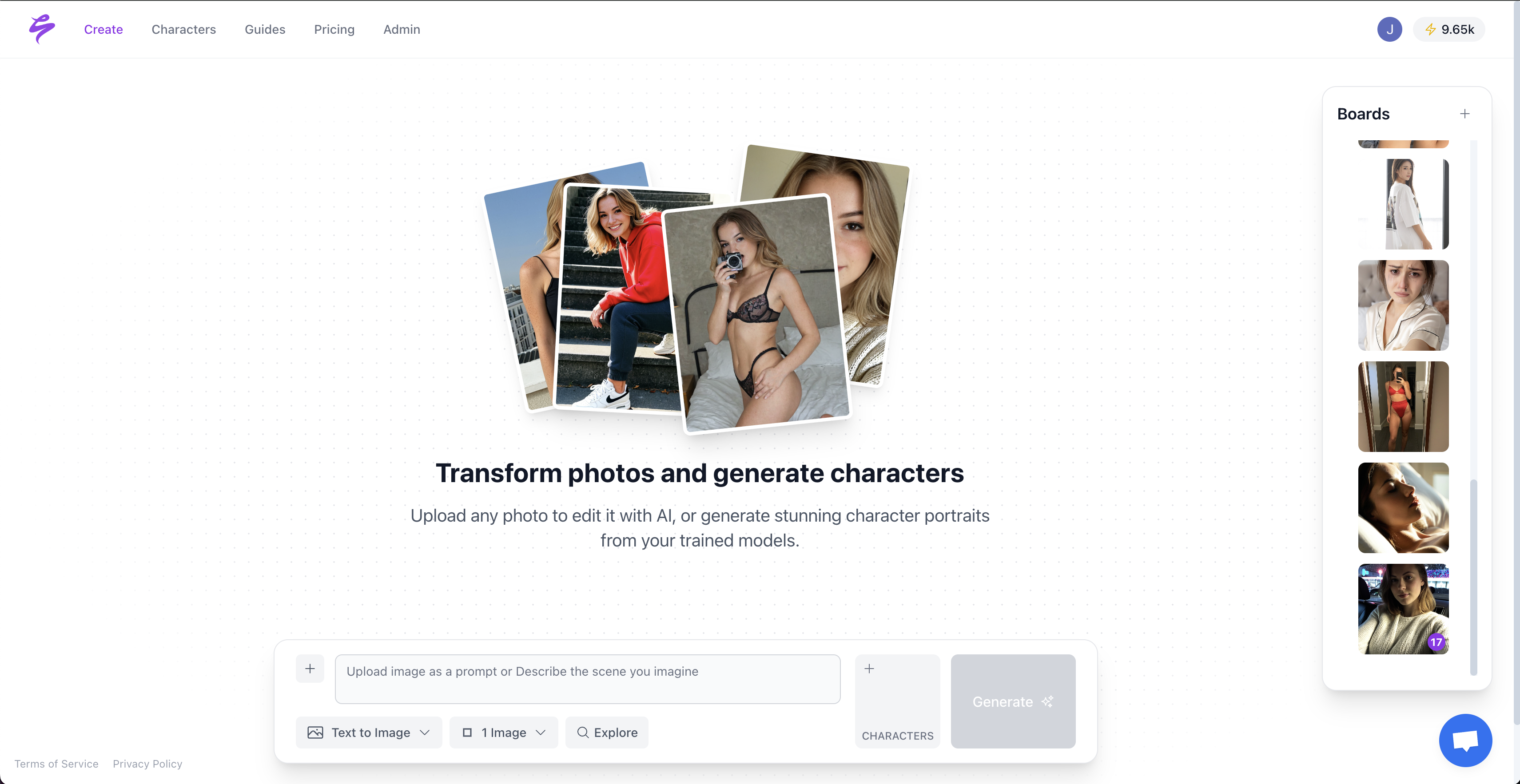
Character Creation starts with as few as three photos to reconstruct a likeness with hyper-realistic accuracy, or you can generate an entirely original character with no source photos. Setup stays instant with no training, no queues, and no technical work.
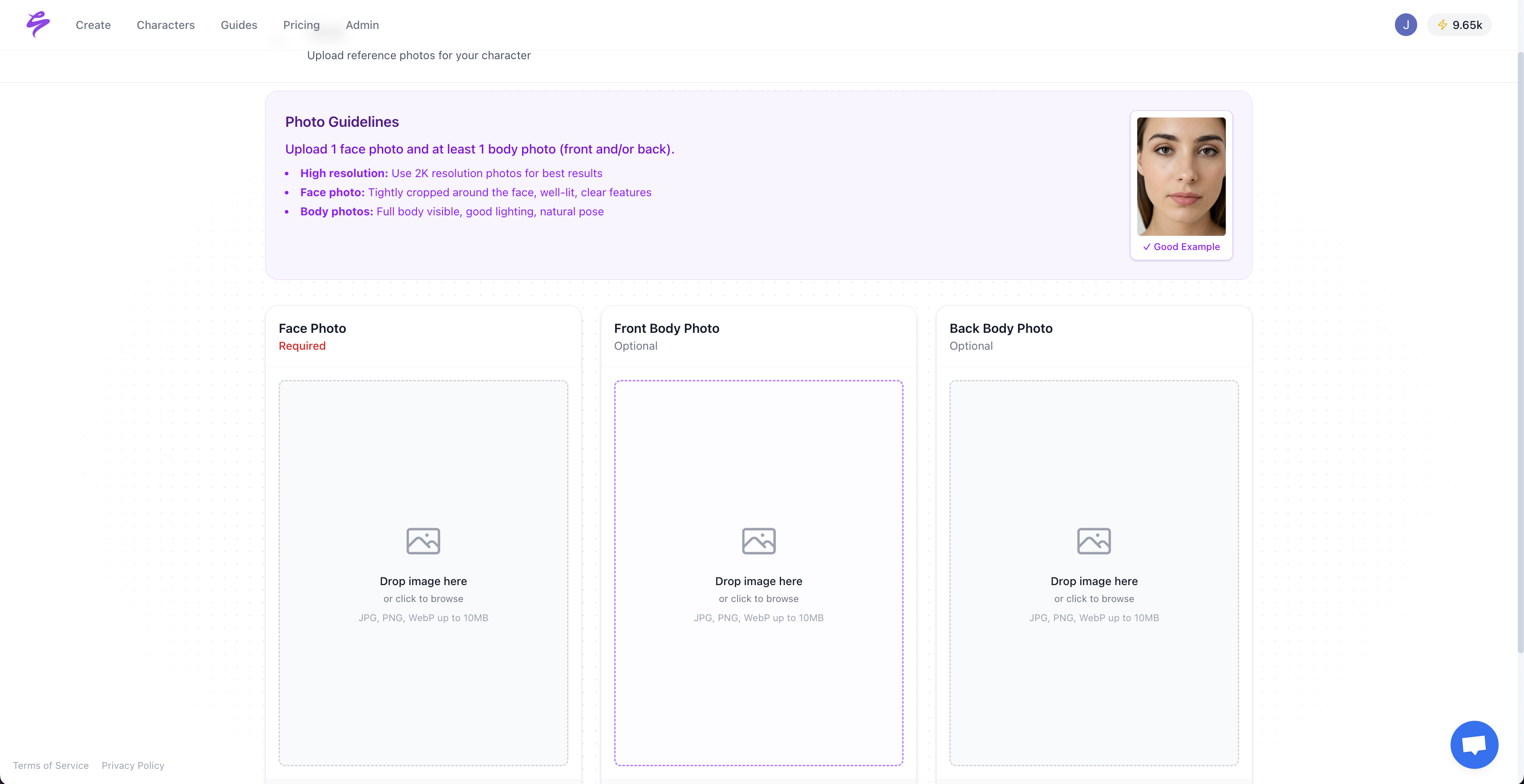
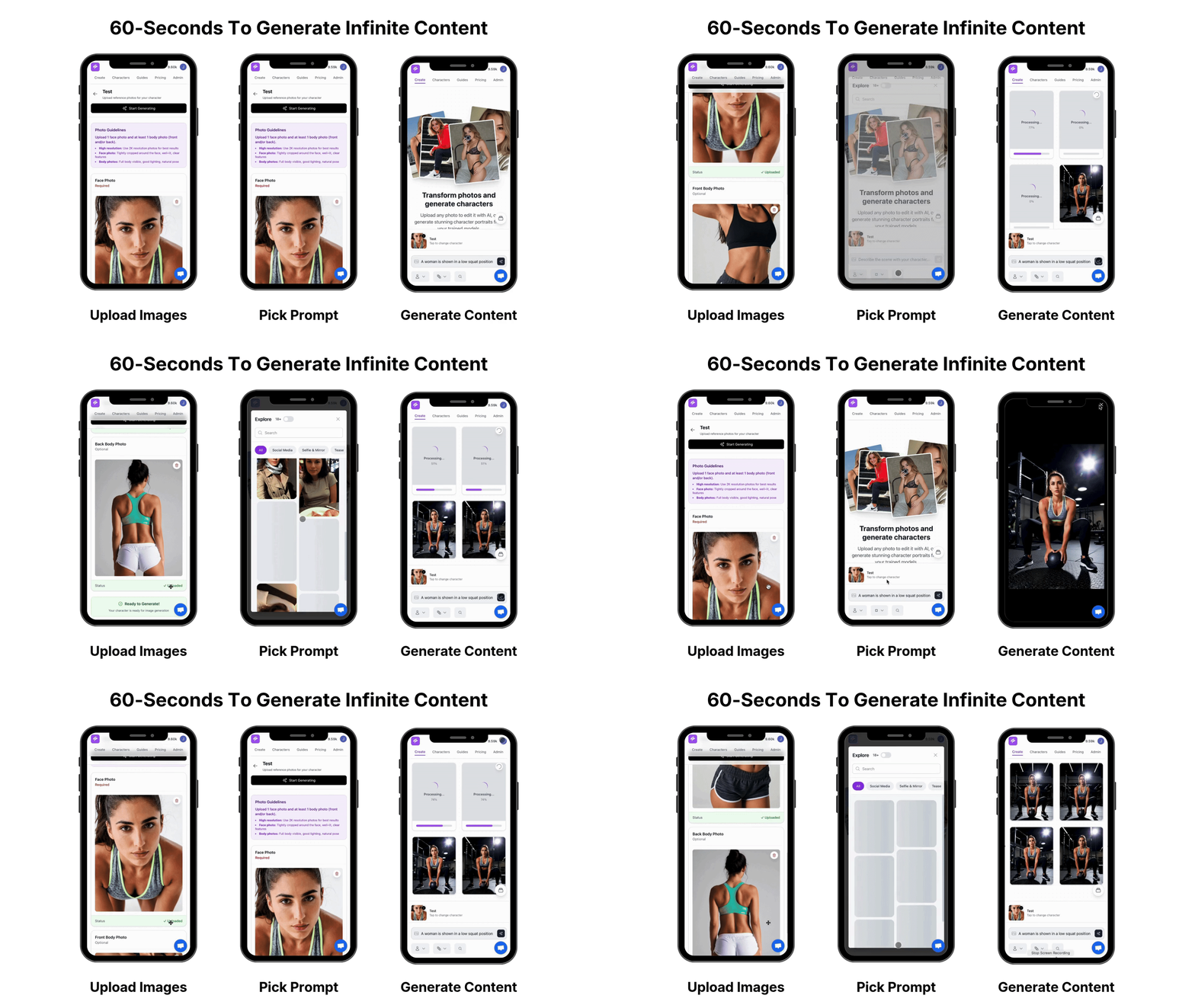
Photo Control turns the prompt bar into a director’s panel with five directable dimensions:
- Setting, which defines where the shoot happens
- Outfit, which defines what the character is wearing
- Shot Style, which defines how the frame looks
- Expression, which defines what the character is giving
- Object, which defines what appears in the scene
Reusable Assets sit behind those controls. Settings become reusable environments built from up to four reference shots. The outfit library assembles a full look from one piece per category such as tops, bottoms, shoes, and accessories. The object library holds up to four props per set. Every element becomes an asset you can re-attach on demand.
Once assets exist, Photo Shoot takes one image and builds a coherent set of up to ten around it. Identity, outfit, and environment stay locked while angle, pose, and expression move. One frame can fuel a month of content.
Those same locked assets carry into Video. You can animate a still, run video-to-video, clone a reel by pasting an Instagram, TikTok, or YouTube link, or generate from text. Output reaches up to 1080p, up to fifteen seconds, in every relevant aspect ratio.
Voice features include voice cloning from a short script or sample. Voice Notes let the character speak to fans without recording anything new.
The Agent interviews you into a finished setup. It resolves character, setting, wardrobe, shot, expression, and output, then writes directly into the prompt bar and Photo Control panel. You move from idea to Generate in one tap.
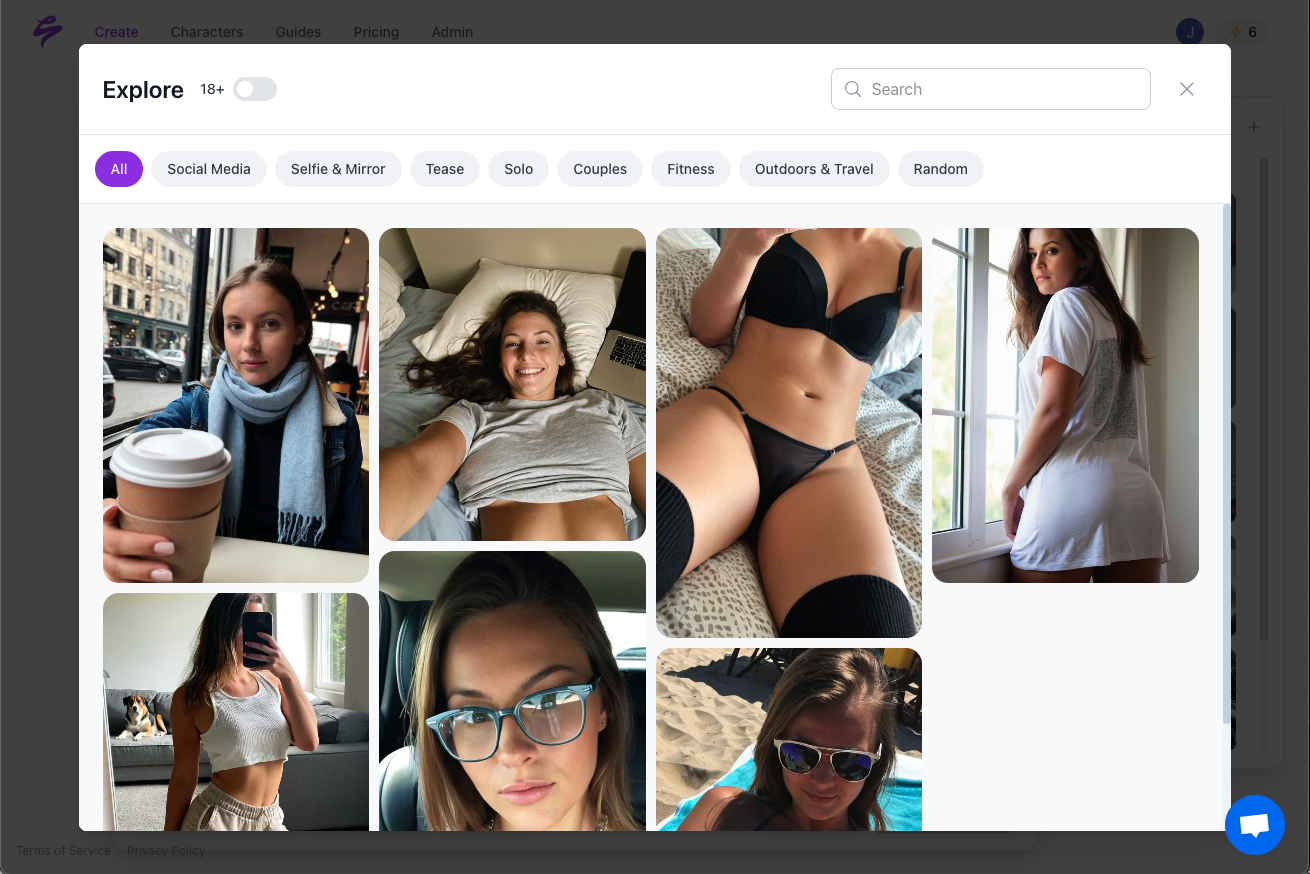
The Vault stores every image, video, voice note, and Live Mode snap in folders you control.
The Scheduler connects Instagram, TikTok, X, Facebook, Reddit, and Fanvue per character. It supports photos, carousels, reels, and stories, with a caption per platform and a live preview.
Analytics separate what Sozee posted from what you posted, so you can measure the platform’s contribution.
Teams And Workspaces give agencies one login with every client fully isolated. Each workspace holds its own characters, vault, connected accounts, and credits.
Sozee functions as a studio that locks likeness, reuses assets, and runs publishing from one place.
Real-World Scenarios: Matching Tools To Your Production Loop
Different creator types need different capabilities. Match your situation to the scenarios below to see where Sozee fits.
- Solo Creators Managing Their Own Content need locked likeness and reusable assets so a month of content comes from one shoot setup. An all-in-one platform with Photo Control and a native Scheduler removes the five-tool export chain.
- Agencies Handling Multiple Creators need isolated workspaces with separate characters, vaults, and connected accounts per client. Channels that grow use a repeatable pipeline, while channels that fail treat each post as an isolated AI generation with no through-line.
- Micro-influencers Delivering Sponsor Campaigns need to drop a sponsor’s product into the Object slot and shoot across multiple settings, looks, and expressions on deadline. Documented AI influencer cases show production cost per Reel around $1–$15 of compute, but only when the character holds across the full deliverable.
- Anonymous Or Niche Creators need full privacy or a fully AI-generated character with no source photos so the persona can never be accidentally exposed.
- Virtual Influencer Builders need daily posting at media-company scale with scheduling and analytics built in. Accounts that skip a week of posting often lose 20 to 30% of their reach momentum and must rebuild it.
The Total Value Of Ownership: Why Consistency Compounds
- Scalability appears when a tool holds consistency past one character so you can run multiple personas without multiplying your workload.
- Operational Efficiency improves because a full week of AI influencer production, such as seven posts including four image posts, two short cinematic videos, and one talking-head video, takes roughly four hours from blank canvas to ready-to-post when run on a single canvas with a shared character library.
- Long-term Compounding comes from every asset you build joining your library. Your world shifts from something you re-describe to something you own.
- The Risk Of Inconsistency stays high. Face drift remains a leading reason new AI influencer accounts fail to build trust. Tools that do not hold a locked likeness force constant re-rolling, burn credits, and produce content that reads as fake within a few images.
Scale A Consistent Virtual Influencer With Sozee
Guided Decision Framework: Solo Creator Vs. Agency Vs. Virtual Influencer Builder
Use the table below to match your situation to the capabilities that matter most and the type of platform to choose.
| Your Situation | What Matters Most | Recommended Approach |
|---|---|---|
| Solo creator | Locked likeness, reusable assets, scheduling | All-in-one platform with Photo Control and Scheduler |
| Agency | Isolated workspaces, multi-character support, analytics | Platform with teams and workspaces plus per-character scheduling |
| Virtual influencer builder | Daily posting, video, voice, scale | Platform with video, voice cloning, and native analytics |
Consistency and reuse should drive the choice. A tool that generates a beautiful image but cannot hold the face across frames stays a demo rather than a business engine.
Frequently Asked Questions
What Free Tiers Actually Allow
Most major platforms, including HeyGen, Kling, Runway, and ElevenLabs, offer free tiers that help with testing and experimentation. They usually limit volume, privacy, repeatability, and identity-locking features, and they often apply watermarks, lower resolution, and public outputs. Cost per approved asset still matters, because heavy drift turns even free generations into expensive time sinks.
What Is The Best AI App For Influencer Marketing?
The best app depends on your production loop. For talking video and localization, HeyGen remains the specialist. For UGC-style ads, Creatify focuses on that workflow. For stills-first workflows with character referencing, Midjourney combined with Runway covers image generation and video animation. For locked likeness and reusable assets across stills, video, scheduling, and analytics in one platform, Sozee is built for consistent scale.
How Do You Keep A Virtual Influencer Consistent Across Posts?
Start every generation from a locked reference such as a trained character model or platform character feature. Build a character reference sheet with front, three-quarter, and profile views before any scene content. Vary scene and outfit while keeping facial identity fixed. Use a platform that saves environments, outfits, and objects as reusable assets so you attach elements instead of retyping descriptions. Always reference the canonical character library directly and test face consistency across 20 to 30 generations before public posting.
Can You Monetize AI-Generated Influencer Content?
Monetization works when you hold commercial rights from your platform and follow disclosure rules. Paid tiers on major AI platforms usually grant commercial rights that cover brand deals, product placements, affiliate promotions, and content sales, while free tiers often prohibit commercial use. Current US guidance treats fully AI-generated works without meaningful human input as non-copyrightable, while human-authored selection, arrangement, and modification can qualify. The FTC requires sponsorship disclosure, and the EU AI Act plus platform policies add synthetic media labels in many cases, so always confirm terms and local rules.
What Is The Best Virtual Influencer Content Generation Tool For Instagram?
The strongest Instagram setup combines native scheduling, vertical formats, and analytics that show what performed. Sozee connects Instagram per character, supports photos, carousels, reels, and stories, and splits analytics between what Sozee posted and what you posted so you can see impact clearly. Instagram’s AI-generated profile label, announced on August 31, 2026, affects reach and recommendations, so a tool with per-character account management and scheduling helps keep disclosure and cadence consistent.
The Production Decision
The virtual influencer tool market is crowded with prompt boxes. A true studio locks likeness, saves environments and outfits as reusable assets, supports video and voice without identity loss, and includes scheduling and analytics so you avoid a five-tool stack.
Generation has become the easy part. Consistency and reuse now define the value of a production platform.
Turn Your Virtual Influencer Into A Scalable Studio Workflow